NVIDIA Declares Robotics’ “ChatGPT Moment” at CES 2026 with “Physical AI” Revolution
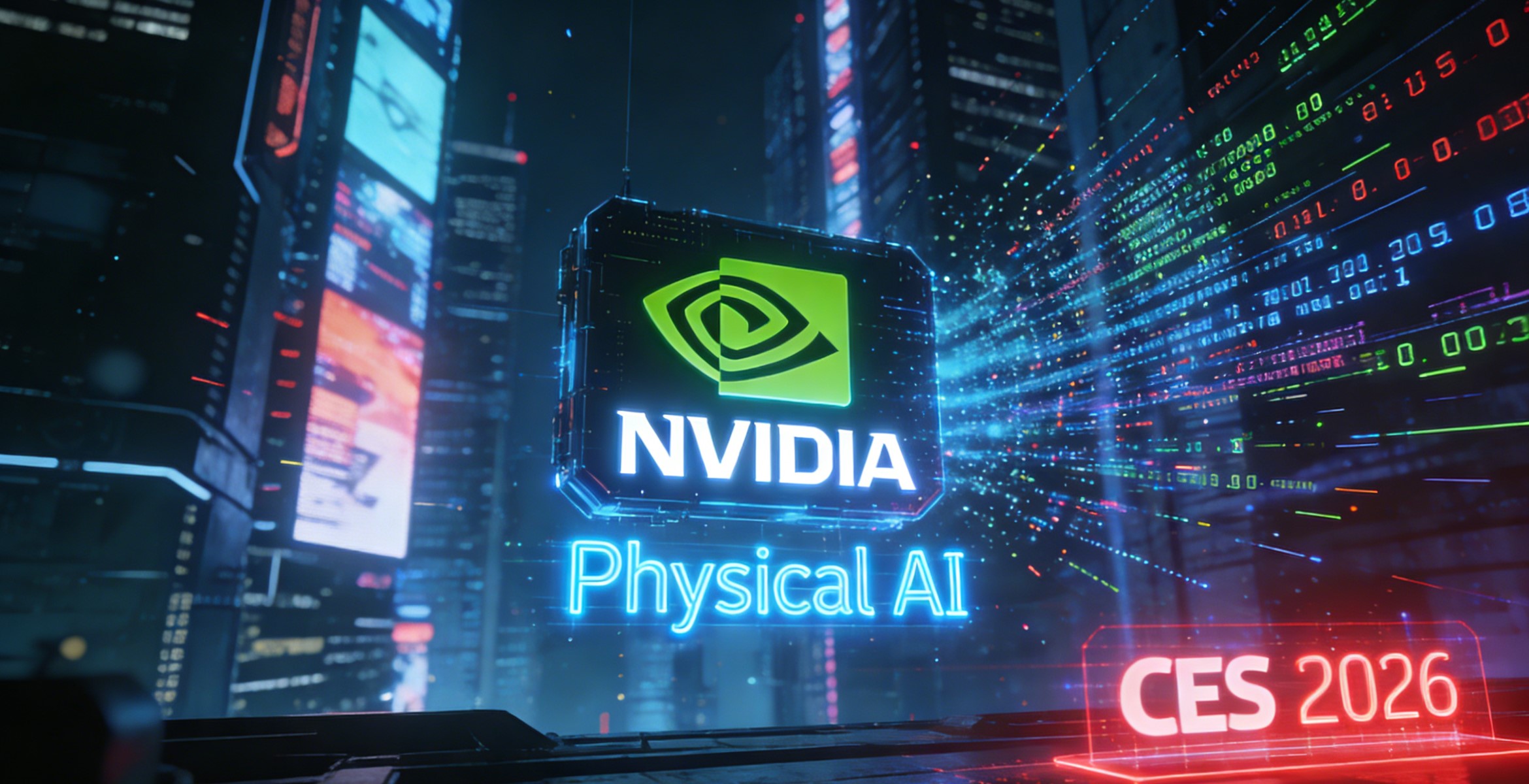
LAS VEGAS — In a pivotal keynote that shifted the focus from pure computing power to real-world interaction, NVIDIA CEO Jensen Huang declared that artificial intelligence is entering a new era. At CES 2026, Huang announced that the “ChatGPT moment” for robotics has arrived, powered by a new generation of “Physical AI” that allows machines to understand and alter the physical world.
Delivering a 90-minute address, Huang framed this as a historic transition. “The core of computing is moving from the CPU to accelerated computing, and the core of software is moving from predefined code to AI,” he stated. He argued that the next frontier is Physical AI, where intelligent systems don’t just process information but learn and reason about physical laws like gravity, friction, and mass to perform complex tasks in the real world.
NVIDIA Declares Robotics’ “ChatGPT Moment” at CES 2026 with “Physical AI” Revolution
The New “Physical AI” Toolkit
To power this shift, NVIDIA unveiled a comprehensive suite of open models and platforms designed to serve as the foundational toolbox for next-generation robotics. The company is effectively providing the industry with the building blocks to create “generalist” robots that can learn multiple tasks, moving away from expensive, single-purpose machines.
The following table summarizes the core components of this new Physical AI stack announced at CES:
| Component | Name | Key Function & Description |
|---|---|---|
| World Model | Cosmos Predict 2.5 & Transfer 2.5 | Open-source models that act as a “learned physics simulator,” predicting the next physical state of the world to give robots real-time “physical intuition.” |
| Reasoning Engine | Cosmos Reason 2 | An open-source visual language model (VLM) that enables multi-step reasoning and planning for complex tasks, such as clearing a cluttered table. |
| Robot Brain | Isaac GR00T 1.6 | The latest open model for humanoid robots, integrating Cosmos Reason for enhanced cognition and enabling full-body coordination for movement and manipulation. |
| Evaluation Framework | Isaac Lab-Arena | An open framework for safely testing and benchmarking robot skills at scale in simulation before real-world deployment. |
| Development Orchestrator | OSMO | A cloud-native platform that simplifies the complex workflow of training AI robots across different computing environments. |
From Simulation to Reality: Bridging the Gap
A central theme of Huang’s vision is overcoming the “sim-to-real gap”—the discrepancy between how a robot performs in a digital simulation and in the messy, unpredictable physical world. NVIDIA’s approach uses its Omniverse digital twin platform and the new Cosmos models to create highly realistic, physics-aware synthetic data for training.
“The training ground has moved into the digital world,” Huang said. By practicing millions of times in simulation, robots can learn generalizable skills before they ever touch real hardware. The Cosmos Transfer 2.5 model is key here, specializing in adapting simulated visuals to look photo-realistic or altering conditions like lighting, which makes the transition from virtual training to real-world execution far more reliable.
An Industry Ready to Build
The announcement was immediately backed by a showcase of industry adoption. Global leaders like Boston Dynamics, Caterpillar, Franka Robotics, LG Electronics, and NEURA Robotics presented new AI-driven robots built on NVIDIA’s technology stack.
In a symbolic demonstration, Huang interacted with a small “Reachy Mini” robot on stage. The robot, trained primarily in simulation, was able to stand up from a prone position on a real wooden floor, vividly illustrating the transfer of a complex physical skill from the digital to the physical realm.
The Road to a Trillion-Dollar Market
Huang positioned robotics as a foundational pillar for future growth, predicting it will evolve into a trillion-dollar market. He described a progression from single-task “specialist” robots to “generalist” machines, and ultimately to what he called “generalist specialists”—highly capable robots that can perform a wide range of complex tasks.
Analysts see this move as NVIDIA leveraging its full-stack ecosystem—from its Jetson edge AI processors and data center GPUs to its AI software and simulation platforms—to cement its role as the essential enabler of the Physical AI economy. By open-sourcing key models, the company aims to accelerate the entire field and establish its platforms as the industry standard.
With the declaration that robotics’ “ChatGPT moment” is here, NVIDIA has set the agenda for the next phase of AI: one where intelligence moves beyond the screen to interact with, and ultimately transform, the world around us.
© Copyright notes
The copyright of the article belongs to the author, please do not reprint without permission.
Related posts




No comments...