
AI Spending Shockwaves: Tech Titans’ $650B Bet Triggers Global Market Sell-Off
February 6, 2026 — The global artificial intelligence sector is experiencing a severe reality check. Investor optimism has abruptly shifted to alarm as major tech companies unveiled plans to spend nearly $650 billion on AI infrastructure this year, triggering a massive global stock sell-off and raising urgent questions about the sustainability of the AI boom.
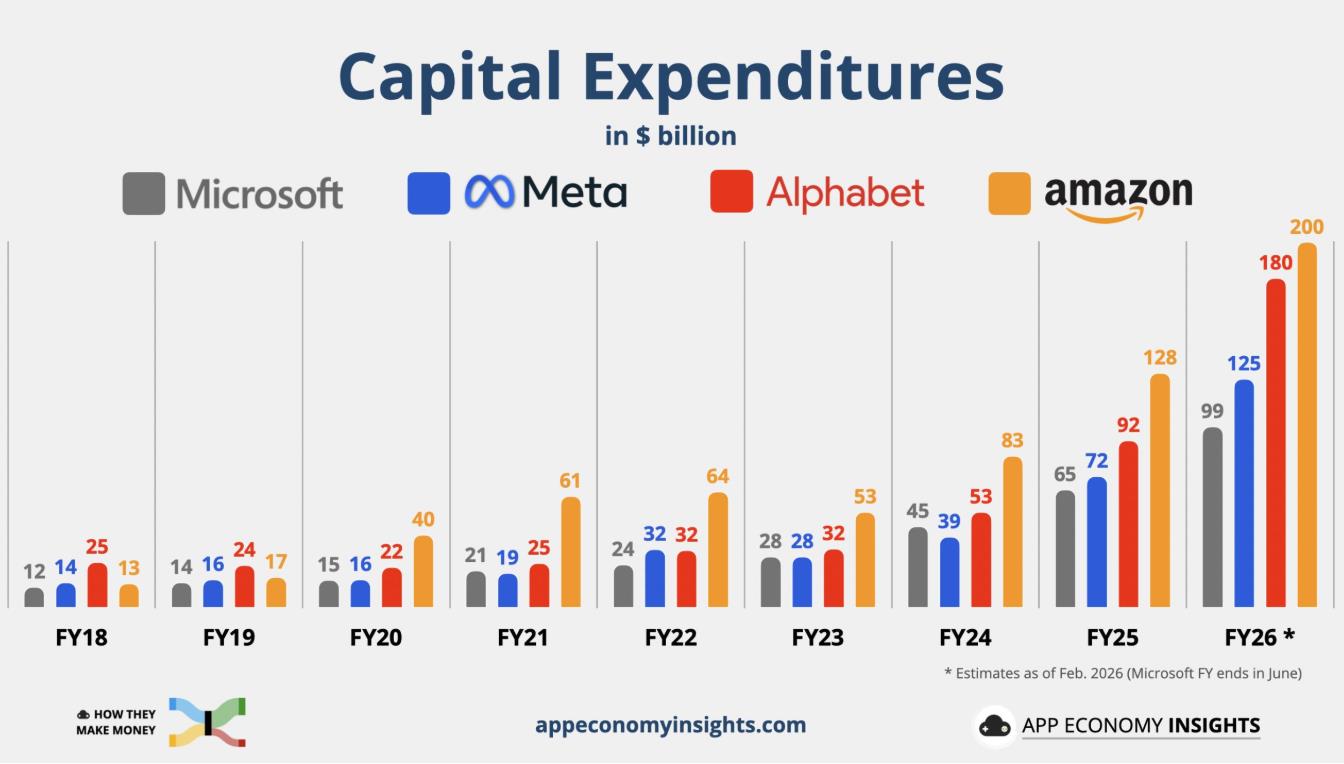
Amazon $200 billion capex
The staggering capital expenditure forecasts from Alphabet, Amazon, Meta, and Microsoft represent an acceleration of spending without parallel this century and have ignited fears of a forming bubble. This financial turmoil unfolds even as leading AI firms like OpenAI and Anthropic roll out their most advanced “agent” technologies, deepening the divide between breakneck technological progress and investor confidence.
The $650 Billion Gambit: A Spending Spree Without Precedent
The scale of planned investment has left markets reeling. Following recent earnings reports, the collective capital expenditure forecast from four tech giants for 2026 has reached approximately $650 billion—a 60% increase from the previous year.
| Company | 2026 Capital Expenditure Forecast | Key Context |
|---|---|---|
| Amazon | ~$200 billion | 50% higher than 2025; exceeded Wall Street expectations by ~37%. |
| Alphabet (Google) | Up to $185 billion | 55% more than analysts expected. |
| Meta Platforms | Up to $135 billion | A potential 87% jump from the previous year. |
| Microsoft | ~$105 billion (Fiscal Year) | Quarterly data center spending surged 66%. |
This planned spending—which alone surpasses the combined projected 2026 capex of 21 major US corporations from automakers to defense contractors—is aimed at building the data centers and securing the advanced chips needed for the next generation of AI.
“The four companies see the race to provide AI compute as the next winner-take-all or winner-takes-most market,” said Gil Luria, an analyst at DA Davidson. “And none of them is willing to lose.” However, this “mind-boggling tide of cash” is testing investor patience, as the market questions when and how these colossal outlays will translate into profitable returns.
Frontier AI Pushes Forward: The Rise of Sophisticated Agents
Amidst the financial anxiety, AI labs are pushing the capabilities of their systems. On February 5, OpenAI announced GPT-5.3-Codex, which it describes as its most powerful intelligent programming model yet, blending advanced coding performance with superior reasoning. More strategically, it launched OpenAI Frontier, a new platform designed to help businesses build, manage, and deploy AI agents that can independently complete complex tasks by integrating with a company’s internal systems.
Rival Anthropic introduced its Claude Opus 4.6 model, boasting major improvements in coding, long-term task execution, and self-debugging. Notably, it reportedly discovered over 500 previously unknown high-risk security vulnerabilities in an open-source library with minimal prompting. Its new “Agent Team” function allows a group of AI agents to divide and conquer large projects in parallel, akin to a “talented team working for the user”.
These announcements underscore a key industry shift. As CEO Sam Altman emphasized, attracting enterprise clients is now a primary focus and a major battleground with competitors like Anthropic.
Global Markets React: From Wall Street to Asian Exchanges
The market’s verdict on the spending spree has been decisively negative. Fears that massive investments are outstripping the near-term profit potential of AI have led to a broad tech rout.
Wall Street: Following the forecasts, Amazon, Alphabet, and Microsoft saw a combined $900 billion in market value evaporate. The Nasdaq Composite suffered its worst three-day period since April 2025.
Asia: The sell-off extended to Asian markets on February 6. Seoul’s market, heavy with tech stocks, fell around 5% at one point. Hong Kong, Shanghai, Singapore, Taipei, and Manila also traded significantly lower.
Investor Sentiment: Analysts note a fundamental shift. “Investors are no longer impressed simply by the presence of AI features,” wrote Charu Chanana of Saxo Markets. The focus is now squarely on which companies will retain pricing power and profitability as AI begins to replicate professional tasks in law, marketing, and software.
Other Key Developments in a Volatile Landscape
The day’s news highlights other critical facets of the global AI scene:
Supply Chain Strain: The AI boom is creating bottlenecks. NVIDIA confirmed it will delay releasing new gaming chips and cut production of current models due to a severe global memory chip shortage, diverting resources to meet data center demand.
China’s Applied AI: Beyond the financial fray, Chinese AI technology is powering the Milano Cortina 2026 Winter Olympics. The IOC has deployed its first official large-language model, developed with Chinese technical support, to assist delegations and the global public with Games information.
Research for Reliability: A cross-institutional research team including Dalhousie University and Meta published findings on detecting “dynamic instability” in AI reasoning—a method to predict when a model is likely to “hallucinate” or fail during complex problem-solving.
Analysis: A Sector in Search of Sustainable Footing
The events of February 5-6, 2026, mark a potential inflection point. The industry is transitioning from a phase of unbounded hype to one of harsh financial scrutiny. The unprecedented capital demands of the AI arms race are colliding with Wall Street’s expectations for disciplined growth and returns.
While the technological advancements in agentic AI are real and accelerating, their economic value must now be proven under the pressure of historic investment levels. The path forward requires tech giants to demonstrate not just revolutionary technology, but also a viable roadmap to profitability. As Steve Lucas, CEO of Boomi, framed the debate: “I would not debate the potential of AI. I would absolutely debate the time frame, and I would passionately debate the economics.”
© Copyright notes
The copyright of the article belongs to the author, please do not reprint without permission.
Related posts




No comments...