
Zhipu AI Makes History as ‘Global Large Model First Stock’ with Hong Kong IPO
In a landmark moment for the artificial intelligence industry, Zhipu AI, a pioneer in China’s quest for artificial general intelligence (AGI), has officially become the world’s first publicly listed large language model company. Trading under the stock code 2513.HK, the company debuted on the Hong Kong Stock Exchange on January 8, 2026. This milestone caps a rapid ascent for the “Tsinghua-born” startup and sets a new benchmark for the valuation and maturity of the global AI sector.
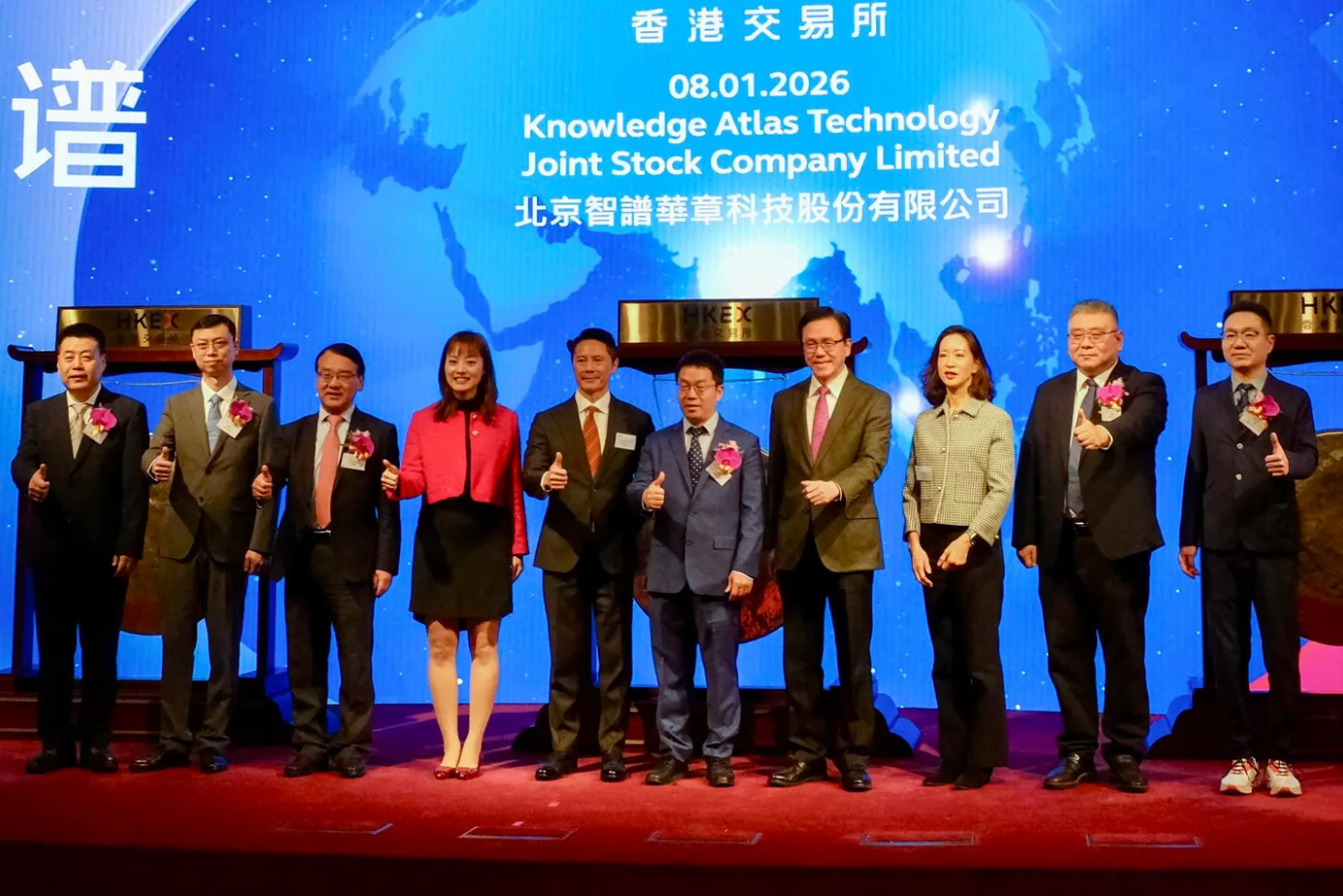
Chinese OpenAI Challenger Zhipu’s IPO Mints New Billionaire
The IPO at a Glance: Strong Backing and Strategic Focus
Zhipu’s entry into the public market was characterized by strong investor confidence and a clear strategic roadmap for its raised capital. The company issued shares at HK$116.20 apiece, opening its first trading day at HK$120.00 with an initial market capitalization of approximately HK$52.83 billion.
The offering attracted a heavyweight roster of cornerstone investors, locking in nearly 70% of the deal. This “all-star” lineup included a mix of international long-term funds, prominent insurance capital, major public funds, and private equity firms. According to its prospectus, the net proceeds from the IPO are strategically allocated:
70% for research and development in general-purpose AI large models.
10% for optimizing its Model-as-a-Service (MaaS) platform.
10% for developing its business partner network and strategic investments.
10% for working capital and general corporate purposes.
From Academic Lab to AI Leader: The Zhipu Trajectory
Founded in 2019 as a commercialization vehicle for technological achievements from Tsinghua University’s Computer Science Department, Zhipu’s mission has been “to make machines think like humans”. The company quickly established itself as a full-stack innovator, developing China’s first proprietary pre-training framework (GLM) and launching a series of benchmark models, including the open-source GLM-130B.
Its commercial strategy revolves around its MaaS platform, providing AI capabilities to enterprises and developers via API calls. This model has driven explosive growth:
| Period | Revenue (RMB) | YoY Growth (2025 H1) | Key Business Milestone |
|---|---|---|---|
| 2022 | 57.4 million | – | Launch of GLM-130B model |
| 2023 | 124.5 million | – | – |
| 2024 | 312.4 million | – | Ranked #1 among China’s independent LLM developers by revenue |
| 2025 H1 | 190.9 million | 325% | Global付费开发者 users for GLM Coding plan exceeded 150,000 |
This growth is underpinned by significant scale: as of late 2025, Zhipu’s models powered over 12,000 enterprise customers, more than 80 million end-user devices, and a global community of over 45 million developers.
Zhipu AI Makes History as ‘Global Large Model First Stock’ with Hong Kong IPO
A Test of Conviction in a Competitive Landscape
Zhipu’s listing is a significant vote of confidence in the “foundation model” path. While some other former peers in China’s “Big Model Six Tigers” have pivoted to vertical applications or embraced third-party models, Zhipu has doubled down on developing its own full-stack, general-purpose technology.
The company’s latest flagship model, GLM-4.7, has demonstrated this commitment by achieving top-tier performance among open-source models on several authoritative public benchmarks, even surpassing some leading global models in specific coding evaluations.
Market Implications and the Road Ahead
Zhipu’s successful IPO sends a clear signal to the global technology investment community. As Alex Zhou, Managing Partner of Qiming Venture Partners (an early backer), stated, the market ultimately recognizes and rewards teams committed to “frontier exploration and deep, foundational technological breakthroughs”.
For Zhipu, the public listing brings not just capital but greater responsibility. CEO Zhang Peng emphasized that the company will continue to deepen its commitment to fully independent, controllable full-stack technology and push the boundaries of AGI capabilities.
The debut of the “global large model first stock” marks more than just a corporate milestone; it signifies the arrival of China’s AI foundational model industry at a new stage of development, one fueled by both technological ambition and capital market validation.
© Copyright notes
The copyright of the article belongs to the author, please do not reprint without permission.
Related posts



No comments...