Qwen (通义千问)Qwen (通义千问)

TongyiQianwen (通义千问), commonly known as Qwen, is a comprehensive family of large language models (LLMs) and an AI assistant developed by Alibaba Cloud. It is a leading force in China‘s AI landscape, renowned for its strong open-source strategy, exceptional performance in reasoning and multilingual tasks (especially Chinese), and its evolution into a versatile, multi-modal AI ecosystem.

🔍 Core Identity and Developer

  • Developer: Alibaba Cloud (阿里云), the cloud computing arm of Alibaba Group.

  • Name Origin: “Tongyi” (通义) signifies universal meaning, and “Qianwen” (千问) means a thousand questions.

  • Core Philosophy: To serve as a reliable “rational brain” for enterprises, providing stable, logical, and consistent AI capabilities for business integration.

✨ Key Technical Highlights and Evolution

Qwen has evolved through several major versions, with Qwen2.5 and the groundbreaking Qwen3 representing its current cutting edge. The table below summarizes its core technical progression and advantages:

Feature / ModelKey Description & Capabilities
Latest Model – Qwen3 (2025)“Hybrid Reasoning” MoE model integrating “fast” (instant response) and “slow” (deep thinking) modes in one. Excels in Agent tasks, coding, and math.
Flagship Model – Qwen2.5 (2024)An open-source series from 0.5B to 72B parameters. Strong in knowledge (MMLU: 85+), coding (HumanEval: 85+), math (MATH: 80+), and supports 128K context.
Multi-Modal ModelsQwen-VL: For visual understanding, document analysis, and scene comprehension. Qwen-ASR/TTS: For accurate speech recognition and natural speech synthesis in multiple languages and dialects.
Core StrengthsLeading open-source model; exceptional Chinese language and reasoning abilities; strong cost-efficiency (Qwen3 uses 1/3 the resources of comparable models); native Agent and tool-calling support.


🌐 The Qwen Ecosystem and Practical Applications

Qwen is more than a chatbot; it’s a full-stack platform.

  • For Developers & Businesses: Models are open-sourced on platforms like Hugging Face and ModelScope under permissive licenses (Apache 2.0), with commercial use allowed. Enterprises can access services via Alibaba Cloud’s “Bailian platform for secure, customized deployment.

  • For General Users: Accessible through the “Tongyi” mobile app and integrated into Alibaba’s ecosystem (e.g., DingTalk).

  • Use Cases: Powers diverse applications like AI coding assistant (Tongyi Lingma), document summarization, creative writing, customer service bots, and multi-modal content creation.

📈 Market Position and Future Direction

Qwen is a top contender among global open-source models. As of 2025, the Qwen family has seen over 3 billion global downloads and spawned more than 100,000 derivative models, indicating massive community adoption. Alibaba frames Qwen3 as a milestone toward Artificial General Intelligence (AGI), shifting focus from training models to developing capable AI Agents

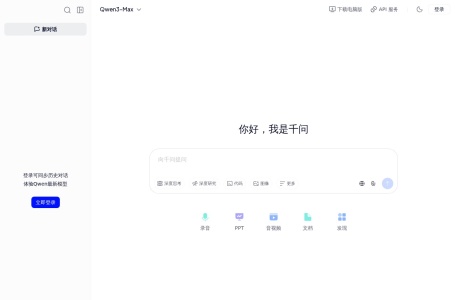
data statistics

Relevant Navigation

Doubao(豆包)

Doubao(豆包)

Doubao is an AI tool developed by ByteDance based on its Skylark model. It provides functionalities such as a chatbot, a writing assistant, and an English learning assistant. It can answer various questions and engage in conversations to help users obtain information. The tool is accessible via a web platform on browsers, dedicated client applications for Windows and macOS computers, as well as iOS and Android mobile platforms. In 2016, ByteDance established its AI Lab, focusing on research in natural language processing, machine learning, data mining, and related fields.
Nano Banana

Nano Banana

Nano Banana (officially Gemini 2.5 Flash Image) and Nano Banana Pro (officially Gemini 3 Pro Image) are image generation and editing models powered by generative artificial intelligence and developed by Google DeepMind, a subsidiary of Google. A text-to-image variant of the Gemini family of large language models, they were launched in August 2025 and November 2025 respectively as features within the Gemini chatbot and other Google products. "Nano Banana" was the codename used for the model while it was undergoing secret public testing on LMArena. Upon release, Nano Banana became a viral Internet sensation on social media, particularly for its photorealistic "3D figurine" images.

No comments

none
No comments...